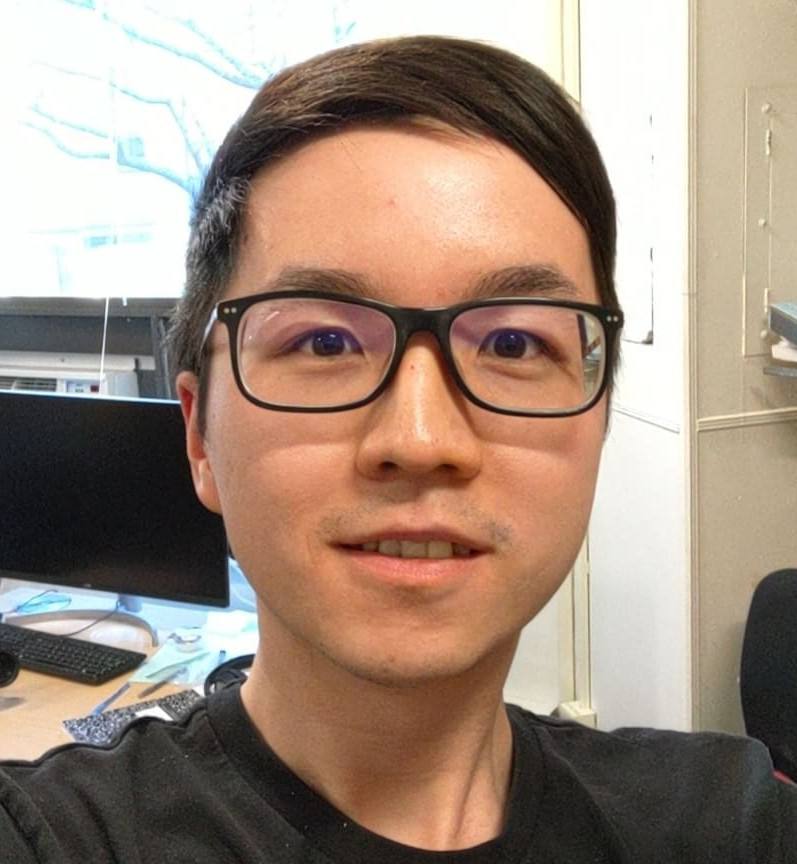
I'm a vision scientist. I design and run experiments on how people see light, dark, and color, and on how the eye focuses, then build quantitative models that explain the results. I also do the engineering this work depends on: calibrating displays, building optical systems, and writing the code that runs experiments and analyzes the data.
For my PhD at Northeastern University, with Rhea Eskew, I showed that the visual system handles increases and decreases in light differently, both for brightness and for the eye's blue-sensitive cones, and built models that account for the difference. Now, as a postdoc in Benjamin Chin's Visual Action Lab at RIT, I study how the eye focuses on objects of different colors.
Two first-author journal papers (Journal of Vision, Vision Research), an invited talk for the Color Technical Group, two talks at the Vision Sciences Society meeting (the field's main annual conference), and multiple poster presentations.
Vision scientist intern at Apple (2024): fundamental psychophysics research and collaboration with cross-functional teams.
Trained in three fields: computer science (B.Eng.), psychology (M.A. and Ph.D.), and now optics and imaging science.
Gave a talk at VSS 2026 on what natural images reveal about response polarity in the cones and chromatic channels. Abstract
Started as a postdoctoral researcher in the Visual Action Lab at RIT.
Defended my dissertation and received my PhD from Northeastern University.
Published a paper on S-cone increments and decrements in Vision Research. Read it
Published a paper on achromatic increments and decrements in Journal of Vision. Read it
Research
Achromatic increments and decrements
PhD research at Northeastern University, published in 2024.
The question: Does vision treat light and dark symmetrically?
What we found: No. Perceived contrast follows a saturating curve for increments and a cubic curve for decrements, and discrimination thresholds are inversely related to the slope of each perceptual scale. A quantitative model was built to dercribe this.
PhD research at Northeastern University, published in 2025.
The question: Does the same asymmetry hold for the short-wavelength (S) cones, whose increments look violet and decrements look yellow-green?
What we found: Not in the same way. Perceptual scales are nearly linear for both polarities, yet discrimination is still asymmetric. A model in which S-cone noise grows with the square root of contrast, unlike the constant noise in the achromatic pathway, accounts for both results.
The question: How does the eye's accommodation response depend on the color of what it is looking at?
The approach: I designed and built a custom optical system that presents stimuli on an OLED display and measures the eye's response with a wavefront sensor. The current study tests how a stimulus's direction in cone contrast space affects how quickly and how accurately the eye refocuses after a sudden change in the target's optical distance. I'm presenting pilot results as a poster at the Optica Fall Vision Meeting 2026.
Effect of direction in cone contrast space on the initiation latency and accuracy of ocular accommodation
Poster at the Optica Fall Vision Meeting, Rochester, NY.
2026
Analysis of natural images reveals response polarity differences in the cones and in the chromatic channels
Talk at the Vision Sciences Society meeting, St. Pete Beach, FL. Abstract
2025
Methods matter: Perceptual scaling of achromatic decrements
Poster at the Optica Fall Vision Meeting, Minneapolis, MN.
2025
S-cone increments and decrements: Nearly-linear perceptual scales and variable noise
Invited talk at Color Data Blast for Early-Career Researchers, Color Technical Group (virtual).
2025
S-cone increment and decrement perceptual scales are nearly linear, but S-cone noise grows with contrast: Results from MLDS and pedestal discrimination
Poster at the Vision Sciences Society meeting, St. Pete Beach, FL. Abstract
2024
Criterion changes might influence the comparison procedure in Maximum Likelihood Difference Scaling (MLDS)
Poster at the Vision Sciences Society meeting, St. Pete Beach, FL.
2023
Criterion effects in maximum likelihood difference scaling: Similar is not always the opposite of different
Poster at the Optica Fall Vision Meeting, Seattle, WA.
2023
The asymmetry between achromatic increments and decrements in perceptual scaling and discrimination
Poster at the Vision Sciences Society meeting, St. Pete Beach, FL. Abstract
2022
Achromatic increments and decrements are different: The relationship between scaling and discrimination
Poster at the Optica Fall Vision Meeting, Rochester, NY. Abstract
2022
Perceptual scaling of suprathreshold chromatic increments and decrements using Maximum Likelihood Difference Scaling
Talk at the Vision Sciences Society meeting, St. Pete Beach, FL. Abstract
Background
Positions
2026–
Postdoctoral Researcher, Rochester Institute of Technology
Visual Action Lab, Chester F. Carlson Center for Imaging Science. PI: Benjamin Chin.
2024
Vision Scientist Intern, Apple Inc.
May to August.
Education
2025
Ph.D. in Psychology, Northeastern University
Dissertation: Asymmetries between increments and decrements in visual perception. Advisor: Rhea T. Eskew, Jr.
2020
M.A. in Psychology, Brandeis University
Thesis: Frequency and duration influence auditory discrimination. Advisor: Robert Sekuler.